
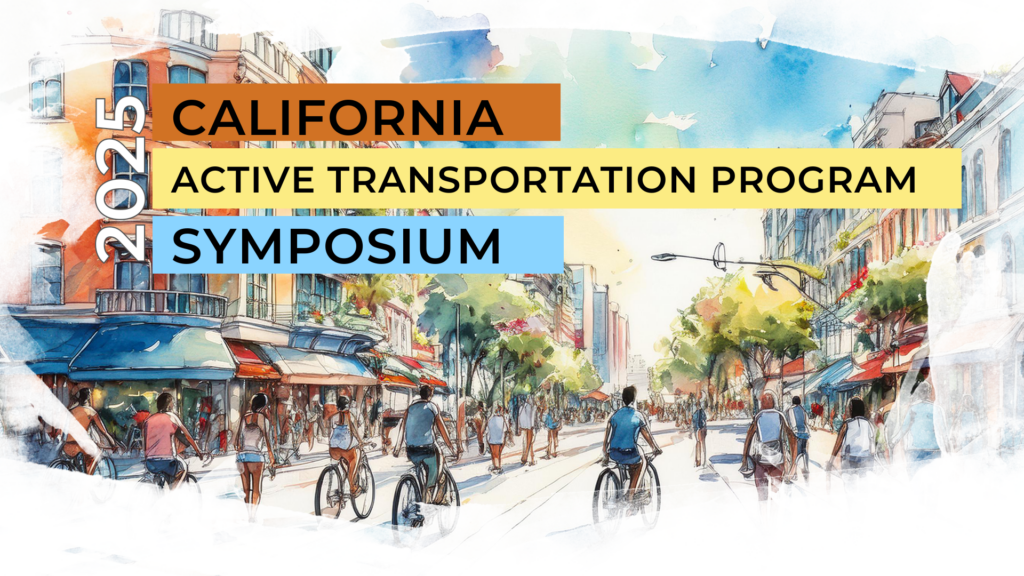
October 22-23, 2025 at the UC Davis Conference Center
The California Active Transportation Program Symposium was a two-day event co-hosted by the California Transportation Commission and Caltrans with support from the Active Transportation Resource Center. The Symposium brought together local, regional, state, and Tribal governments to learn, share knowledge, and network with other agency staff, planners, engineers, public health professionals, and active transportation champions implementing active transportation projects. This two-day event included inspiring speakers, interactive workshops, breakout sessions, and opportunities to connect with partners to further work. The 2025 event was the first in-person symposium since 2019, with the 2021 event held virtually. You can look forward to the next ATP Symposium that will be held in 2027.
Livestream Recordings
October 22, 2025
Keynote – Safety and the Safe Systems Approach
Welcome from Congressman Mike Thompson & Plenary – Climate and Resiliency: Active Transportation’s Role
October 23, 2025
Keynote – The Future of Active Transportation and Funding in California
Plenary – Making Engagement Work: Cross-Agency Lessons in Active Transportation & Closing Remarks
The session presentation materials and resources can be found under the individual session listings on the agenda tab.
Note: AICP CM credits are available for most sessions under event #9317703.
Tuesday, October 21, 2025
Optional Pre-Symposium Tours and Training (see Additional Activities tab)
Wednesday, October 22, 2025
Click on the arrows to view details.
8:30 am - Registration and Breakfast
Breakfast will be available in the lobby.
9:30 am - Welcome and Opening Remarks
Opening remarks will be shared to welcome attendees to the 2025 Active Transportation Program Symposium.
Welcome: Alissa Kendall Slides
Congressman Thompson Welcome Video
Presenters:
Alissa Kendall, Director, Institute of Transportation Studies, and Ray B. Krone Endowed Professor of Environmental Engineering, UC Davis
Darnell Grisby, Chair, California Transportation Commission
Tanisha Taylor, Executive Director, California Transportation Commission
Location: Ballroom
10:00 am - Keynote - Safety and the Safe Systems Approach
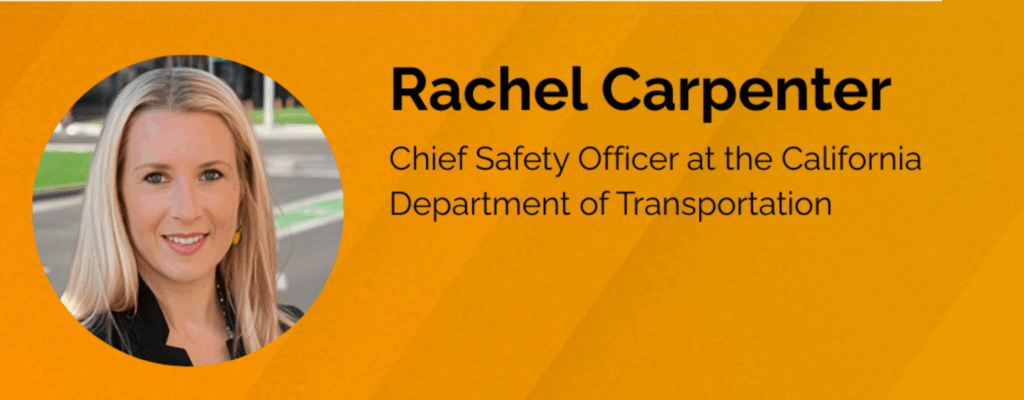
Rachel Carpenter’s keynote reframes road safety as a preventable injury problem grounded in the Safe System Approach and public-health practice. She’ll introduce a simple, actionable lens (manage exposure, likelihood, and severity) to guide decisions in planning, design, operations, and policy. At a high level, she’ll highlight population-level levers: human-tolerant speeds, complete and protected networks, safer intersections, and land-use/access choices that reduce unnecessary risk, with equity embedded from the start. The session focuses on shifting mindsets, clarifying the “why” behind safety choices and how agencies can rally around injury prevention to reduce deaths and serious injuries.
Presenter:
Rachel A. Carpenter, Chief Safety Officer, Caltrans
Location: Ballroom
10:45 am - Break
Networking in the lobby.
11:00 am - Plenary - Climate and Resiliency: Active Transportation’s Role
The effects of climate change have arrived, and they’re here to stay. Active transportation plays a larger role than just lessening the inputs driving the crisis. This interdisciplinary panel of leaders will share how they are implementing diverse strategies, ranging from landscaping to economic equity, and discuss the role of active transportation in these efforts.
Plenary – Climate & Resiliency in Active Transportation Slides
Moderator:
Michael Hutnick, Caltrans
Presenters:
Trinity Smyth, California Department of Public Health
April Webster, Strategic Leader for Climate-Resilient and Inclusive Transportation
Adrienne St John, Caltrans
Megan Johnson, City of Sacramento
Location: Ballroom
12:15 pm - Lunch
Lunch will be served in the lobby.
1:30 pm - Breakout Sessions
Non-Infrastructure Is Not An Afterthought: How to Build Community and Partnerships While Building Your Active Transportation Projects
Changing transportation behavior takes more than building sidewalks and bike lanes. Education and encouragement activities are funded in the Active Transportation Program as non-infrastructure projects. Panelists will discuss the importance of non-infrastructure programs in changing how a community travels and model varied approaches to creating successful applications and implementing non-infrastructure programs for all ages. Panelists will share how they chose partners and developed their successful project application selected for Active Transportation Program funding.
Non-Infrastructure Is Not An Afterthought Slides
Moderator:
Jeanne LePage, Ecology Action
Presenters:
Kerri Vanderbom, Butte County Public Health
Rachel Tow, Butte County Public Health
Ariana Green, Transportation Agency for Monterey County
Leann Leon, Ecology Action
Location: Ballroom A
Bridging the Gap: Active Transportation and Transit Integration
Getting to and from transit shouldn’t be the hardest part of the trip. Dive into how active transportation can close the first and last mile gap. This panel includes practitioners and academics working to connect people to transit. From new infrastructure projects to policy shifts to international solutions, this session will explore what it takes to build safe, seamless, and people-centered mobility options.
Moderators:
Peter Rossi, Caltrans
Diego Corvera, City of Visalia
Presenters:
Audrey Ogden, Caltrans Division of Transportation Planning
David Sorrell, San Joaquin Regional Rail Commission
Kari Watkins, UC Davis
Location: Ballroom B
Leveraging Art as an Engagement, Placemaking, and Safety Strategy
Learn how art is being leveraged as an engagement, placemaking, and transportation safety strategy across the state in rural, suburban, urban, and Tribal communities. Sidewalk poetry and art on the asphalt are examples of the successful integration of art into active transportation infrastructure. Engage in a discussion on creative and diverse funding strategies, how to balance innovation with regulations such as the Manual on Uniform Traffic Control Devices (MUTCD), and how to establish and maintain partnerships to facilitate meaningful engagement and long-term investment in art in transportation. Attendees will leave this session equipped with actionable strategies and inspiration to incorporate meaningful art into transportation planning and infrastructure in their communities.
SCAG’s Go Human Program: Alina Borja Slides
Mariposa County City Planning: Ben Goger Slides
Asphalt Art: Rancho Cordova Slides
Moderator:
Rachel Om, Southern California Association of Governments
Presenters:
Alina Borja, Southern California Association of Governments
Ben Goger, Mariposa County
Drew Hart, City of Rancho Cordova
Ian Winbrock, City of Rancho Cordova
Location: Ballroom C
2:30 pm - Break
Networking in the lobby.
2:45 pm - Breakout Sessions
Riding the Electric Wave: Incorporating E-bikes and Micromobility into Our New Transportation Landscape
In recent years, there has been an increase in the prevalence of e-bikes and other electric mobility options, and technology often outpaces policy and infrastructure. Many local agencies are grappling with developing policies that address speed differentials, safety considerations, and facilitate mode shift. Further, policy and design strategies for device parking, curb management, and education of road users are often required. This session will discuss how to effectively incorporate electric mobility devices into active transportation networks, build in support systems for all users, and plan for the future. Speakers representing the non-profit sector, a public university campus, and the bicycle industry will review education, incentives, policy considerations for local jurisdictions, and promising infrastructure changes.
Riding the Electric Wave Slides
Moderator:
Kendra Ramsey, California Bicycle Coalition
Presenters:
Jeanie Ward-Waller, Fearless Advocacy
Matt Miller, Ecology Action
Jeff Bruchez, UC Davis Transportation Services
Location: Ballroom A
People Experiencing Homelessness and Active Transportation
Active transportation plays a significant but often overlooked role in the lives of people experiencing homelessness. Join this session to learn about the unhoused population in California and how transportation planning and design decisions affect their safety and quality of life. Panelists will also discuss the importance of including the voices of those currently or previously experiencing homelessness in community engagement activities.
People Experiencing Homelessness Slides
Moderator:
Emily Pereira, California Department of Public Health
Presenters:
Alicia Lehmer, Homebase, The Center for Common Concerns
Mar-y-sol Pasquiers, California Department of Public Health
Akenese “Agnes” Luluga, Asian Resources, Inc.
Veronica Hahni, Los Angeles Neighborhood Initiative
Location: Ballroom B
Sovereignty and Synergy: Tribal Partnerships for Successful Active Transportation Program Projects
Strong partnerships with Tribal governments can lead to successful, collaborative active transportation projects. This session will focus on the partnership between the Karuk Tribe and Caltrans District 2 to deliver the Happy Camp Complete Streets Project. The journey wasn’t always easy, but led to a successful partnership and project delivery. Learn about the journey which included outreach by Caltrans District 2 to the Karuk Tribe, trust building between the two groups, a successful Active Transportation Program Cycle 5 funding award, and an agreement option that honored Tribal Sovereignty while enabling state support. This session will share strategies for Tribal-State collaboration, lessons learned, and leveraging Caltrans’s partnerships with Tribal communities to achieve shared active transportation goals.
Moderator:
Kendee Vance, Caltrans
Presenters:
Tamy Quigley, Caltrans
Misty Rickwalt, Karuk Tribe
Location: Ballroom C
3:45 pm - Break
Networking in the lobby.
4:00 pm - Breakout Sessions
Implementing Street Safety for the Disabled Community
Did you know that without the disability community, curb cuts wouldn’t exist? The disability communities are too often forgotten as municipal agencies seek to implement new street safety infrastructure, yet when their needs are factored in, the design benefits all Californians. This session will draw on the personal experiences of a diverse group of California disability advocates working to elevate the needs of their communities. The panel will discuss universal design principles and how incorporating such principles in transportation planning and infrastructure will inform better design decisions that can satisfy the needs of all Californians.
Moderators:
Kevin Shin, California Walks
Beck Levin, Disability Rights California
Presenters:
Warren Cushman, Community Resources for Independent Living
Alexa Guerrero, Community Organizer living in Placer County
Peggy Martinez, Creative Inclusion
Location: Ballroom A
Finding Creative Ways to Fund Active Transportation Projects
The Active Transportation Program is the state’s only dedicated source of funding for walking and biking projects. The program remains oversubscribed, with a backlog of critically needed, high-quality projects that go unfunded every program cycle. This leaves California agencies with limited options to fund active transportation improvements in their communities. This session will focus on strategies to fund active transportation improvements and discuss other funding sources available. Speakers will share their knowledge and expertise on other programs that fund active transportation improvements, and discuss strategies utilized for successful applications in the Active Transportation Program.
Moderator:
Laurie Waters, California Transportation Commission
Presenters:
Ella Manashil, California Strategic Growth Council
Joey Juhasz-Lukomski, Shared Use Mobility Center
Maura Twomey, Association of Monterey Bay Area Governments
Lina Moeller, iBank
Location: Ballroom B
Bike Parking: A Critical Support for Bicycling
Supporting people on bicycles doesn’t stop at the bike lane. Bicycling is a viable transportation option only when there is a secure place to park or store your bike at the end of the trip. There are many considerations for bike parking, from location and site planning to materials selection, installation, and maintenance. Panelists in this session will provide an overview of the upcoming update to the Association of Pedestrian and Bicycle Professionals (APBP) bike parking guidelines, share insights from bike parking programs in California, and discuss best practices for success.
Moderator:
Michelle Lieberman, Institute of Transportation Studies, UC Davis
Presenters:
Mauricio Hernandez, Alta Planning + Design
Anne Wallach Thomas, Shasta Living Streets
Jeff Jelsma, City of Sacramento
Location: Ballroom C
5:00 pm - End of Day 1
See you tomorrow!
Thursday, October 23, 2025
Click on the arrows to view details.
8:00 am - Breakfast
Breakfast will be available in the lobby.
9:00 am - Breakout Sessions
Active Transportation on Rural Main Streets
Active transportation projects have many health, safety and economic benefits – but what are the impacts of a completed project in a rural community? Rural communities are often bisected by a state highway, or a main street throughway. These corridors maintain local businesses, historic landmarks, and community social hubs, which are integral to cultivating economic vitality and community identity. This session focuses on the impacts of active transportation facilities in rural regions, specifically on rural main streets. The speakers will share their depth of experience on community-supported improvements, planning measures considered to address impacts of climate change, and how investments in active transportation improves the livelihood of people living in rural communities across California.
Moderator:
Lee Ann Eager, Commissioner, California Transportation Commission
Presenters:
Wendy Sugimura, Mono County
Marc Mattox, Town of Paradise
Eloy Ortiz, Regeneración – Pajaro Valley Climate Action
Location: Ballroom A
Thinking Outside the Engagement Box
Community-based organizations, consultants, and transportation agencies are reimagining engagement through innovative, collaborative approaches that go beyond traditional public meetings. This dynamic panel will showcase groundbreaking strategies that build trust, create meaningful partnerships, and center community voices in active transportation planning. Experts from across California will share transformative techniques that empower residents, bridge institutional gaps, and develop more inclusive, responsive transportation solutions.
Transportation Sensory Based Engagment Slides
San Mateo County Thinking Outside the Engagement Box Slides
Pacoima Beautiful & LA Metro Community Partnership Slides
Moderator:
Kiara Reed, Civic Thread
Presenters:
James Rojas, Place It!
Theresa Vallez-Kelly, San Mateo County Office of Education
Kristin Haukom, Alta Planning + Design
Jacob Lieb, LA Metro
Roxy Rivas, Pacoima Beautiful
Matt Biggar, Connected to Place
Location: Ballroom B
Telling Your Story: Crafting a Compelling Grant Narrative
How do you craft a compelling story to get your project funded? Panelists in this session will discuss how to highlight the major impacts of your projects: why it matters, who it benefits, and how the community will change in positive ways. The session will also discuss the data and tools available to help tell your story.
Presenters:
Claire Gallogly, City of Santa Cruz
Dillon Fitch-Polse, Institute of Transportation Studies, UC Davis
Julia Griswold, UC Berkeley SafeTREC
Kari McNickle, Fehr and Peers
Location: Ballroom C
10:00 am - Break
Networking in the lobby.
10:15 am - Workshop Sessions
Beyond the Count: New Ways to Measure Active Transportation Project Success
Join us for an introduction to the Active Transportation Resource Center’s Counts+ Technical Assistance pilot program, exploring new ways to measure the success of your active transportation project. This pilot program will explore evaluation metrics that capture additional benefits generated by projects while keeping the burden of work low for participants. The session will include a brief introduction to the pilot program, and then we’ll head outside for a hands-on demonstration of Counts+. At the end of the session, we’ll discuss how you can request technical assistance for your active transportation project and answer any outstanding questions.
Presenters:
Dru van Hengel, Nelson\Nygaard
Tracy McMillan, Nelson\Nygaard
Alexandra Weber, Nelson\Nygaard
Carolyn Chu, Nelson\Nygaard
Location: Ballroom A
Designing Bikeable Intersections with NACTO Guidance
The National Association of City Transportation Officials’ (NACTO) new edition of the Urban Bikeway Design Guide is the blueprint for implementing safe, connected, and equitable bike networks. Its how-to guidance covers city policy, network planning, community collaboration, program and project evaluation, bikeway design, curb management, intersection design, maintenance, and operations. Precise, actionable illustrations and diagrams help everyone work toward safe, bikeable cities.
In this hands-on session, you will learn about the Guide’s holistic approach to bikeable streets and focus on proven geometric designs and traffic control strategies. You’ll roll away with the skills to make your city’s bikeway intersections safe and inviting for people of all ages and abilities. Anyone involved in design, from scoping to approvals, will benefit from this session.
To purchase your own hard copy (or e-book), use discount code UBDG3 at www.nacto.org/bike-guide
To browse online, find the guide here: https://nacto.org/
Presenters:
Cary Bearn, NACTO
Sophia Benner, NACTO
Location: Ballroom B
Quick is the Name
Quick Build projects are not a new concept in the toolbox of local agencies, but the name Quick Build has become the term used to describe low-cost pilot projects in recent years. A panel of local agency staff will candidly discuss Quick Build project examples and their challenges, implementation strategies, and tips for success.
Quick is the Name Paul Martin Slides
Quick Build Charlie Ream Slides
Moderator:
Cory Wilkerson, City of Anaheim
Presenters:
Marina Ramirez, Mark Thomas
Paul Martin, City of Costa Mesa
Charlie Ream, City of Oakland
Location: Ballroom C
Walk Safe and Bike Safe Program Demonstration
Experience Ecology Action’s Walk Safe and Bike Safe program firsthand. Hop on a bike and ride the bike rodeo course to learn how these educational events help children (and adults) practice and develop skills that will help them to become more confident and safer bicyclists. Take a short walking field trip to see how pedestrian safety skills are taught and practiced. Participants will have time to experience both programs.
Presenters:
Ecology Action
Location: Arboretum Drive
12:15 pm - Lunch and Poster Session
The Poster Session will feature completed Active Transportation Program projects.
Location: Lobby and Patio
1:45 pm - Keynote - The Future of Active Transportation and Funding in California
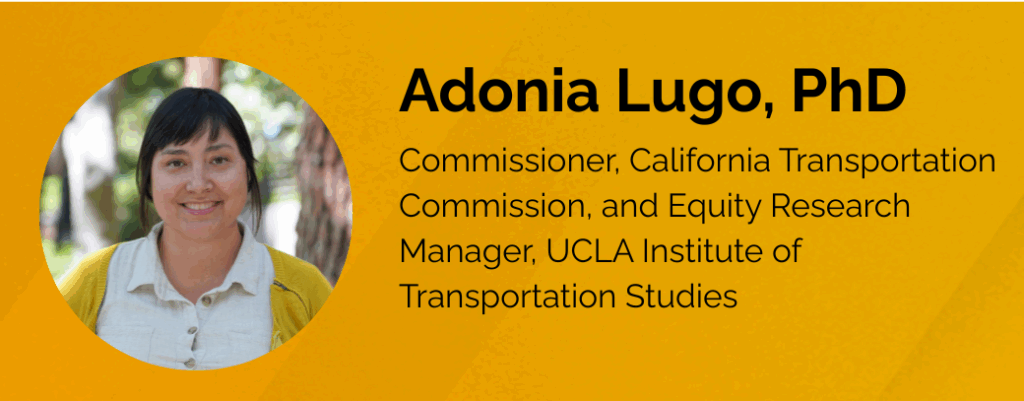
There is always more demand than available state funding for active transportation. In this talk, Commissioner Lugo will share examples of projects funded through programs other than the Active Transportation Program (ATP), explore how non-infrastructure programs play a vital role in the shift to sustainable transportation, and introduce a new research project that will focus on workforce and labor as a strategy for advancing active transportation.
The Future of Funding and Active Transportation in California Slides
Presenter:
Adonia E. Lugo, PhD, Commissioner, California Transportation Commission and Equity Research Manager, UCLA Institute of Transportation Studies
Location: Ballroom
2:35 pm - Break
Networking in the lobby.
2:45 pm - Plenary - Making Engagement Work: Cross-Agency Lessons in Active Transportation
Successful active transportation projects often require close cross-agency collaboration and strong partnerships. Hear from local and state agency representatives and active transportation leaders about the keys to successful collaboration across sectors, the lessons they have learned from past projects, and the importance of engaging different agencies and the community.
Making Engagement Work: Clarissa Falcon Slides
Street Trauma Prevention: Vision Zero and Fire Service Slides
Making Engagement Work: Madilyn Jacobsen Slides
Engaging Communities in the Active Transportation Program Slides
Moderator:
Nailah Pope-Harden, Caltrans
Presenters:
Clarissa Reyes Falcon, Vice Chair, California Transportation Commission
Mike Wilson, Berkeley Disaster and Fire Safety Commission
Madilyn Jacobsen, Caltrans District 5
Jenny Pen-Bell, Kern County Public Works
Location: Ballroom
4:00 pm - Closing Remarks
Closing Remarks: Toks Omishakin Slides
Presenters:
Darnell Grisby, Chair, California Transportation Commission
Dina El-Tawansy, Director, Caltrans
Tanisha Taylor, Executive Director, California Transportation Commission
Toks Omishakin, Secretary, California State Transportation Agency
Location: Ballroom
4:30 pm - End of Day 2
Thank you for joining us!
Keynote Speakers
Session Panelists and Moderators
Adrienne St John – Senior Landscape Architect, Complete Streets Liaison, Caltrans
Akenese “Agnes” Luluga – Site Director, Asian Resources, Inc.
Alejandro Cabello-Lopez – Program Coordinator, Ecology Action
Alexa Guerrero – Community Organizer and Advocate
Alexandra Weber – Senior Associate Transportation Planner, Nelson\Nygaard
Alicia Lehmer – Directing Analyst, Homebase, The Center for Common Concerns
Alina Borja – Senior Regional Planner, Southern California Association of Governments
Alissa Kendall– Ray B. Krone Endowed Professor of Environmental Engineering, UC Davis
Alma Diaz – Youth Program Coordinator, Ecology Action
Anne Wallach Thomas – Executive Director, Shasta Living Streets
April Webster – Strategic Leader for Climate-Resilient and Inclusive Transportation
Ariana Green – Principal Transportation Planner, Transportation Agency for Monterey County
Audrey Ogden – Active Transit Performance Measure Manager & Complete Streets Program Manager, Caltrans Division of Transportation Planning
Beck Levin – Diversity Coordinator, Disability Rights California
Ben Goger – Senior Planner, Mariposa County
Carolyn Chu – Senior Associate, Nelson\Nygaard
Cary Bearn – Senior Manager, Multimodal Design and Programs, NACTO
Charlie Ream – Supervising Transportation Planner, City of Oakland
Chris Alonso – Program Coordinator, Ecology Action
Claire Gallogly – Principal Transportation Planner, City of Santa Cruz
Clarissa Reyes Falcon – Vice Chair, California Transportation Commission and Principal Consultant, Falcon Strategies
Cory Wilkerson – Principal Transportation Planner, City of Anaheim
Daniel Velasquez – Program Coordinator, Ecology Action
Darnell Grisby – Chair, California Transportation Commission and Senior Fellow, Beneficial State Foundation
David Sorrell – Senior Regional Planner, San Joaquin Regional Rail Commission
Diego Corvera – Senior Civil Engineer, City of Visalia
Dillon Fitch-Polse – Research Faculty, Institute of Transportation Studies, UC Davis
Dina El-Tawansy – Director, Caltrans
Drew Hart – Senior Transportation Planner, City of Rancho Cordova
Drusilla van Hengel – Senior Principal, Nelson\Nygaard
Ella Manashil – Associate Planner, CA Strategic Growth Council
Eloy Ortiz – Special Projects Manager, Regeneración – Pajaro Valley Climate Action
Emily Pereira – Housing & Homelessness Equity Specialist Community Inclusion and Partnerships Section, California Department of Public Health: Office of Health Equity
Gabriela Bravo – Program Coordinator, Ecology Action
Ian Winbrock – Management Analyst II, City of Rancho Cordova
Jacob Lieb – Deputy Executive Officer, First/Last Mile Planning, LA Metro
James Rojas – Place It!
Jeanie Ward-Waller – Director of Transportation Advocacy, Fearless Advocacy
Jeanne LePage – Strategic Fund Development Director, Ecology Action
Jeff Bruchez – Active Modalities Manager, UC Davis
Jeff Jelsma – Transportation Planner, City of Sacramento
Jenny Pen-Bell – Supervising Planner, Kern County Public Works
Joey Juhasz-Lukomski – Senior Program Manager, Shared Use Mobility Center
Juan Castillo – Program Manager, Ecology Action
Julia Griswold – Director, UC Berkeley SafeTREC
Kari McNickle – Senior Associate, Fehr & Peers
Kari Watkins – Professor of Civil and Environmental Engineering, UC Davis
Kendee Vance – District 2 Native American Liaison, Caltrans
Kendra Ramsey – Executive Director, California Bicycle Coalition
Kerri Vanderbom – Program Manager, Butte County Public Health
Kevin Shin – Co-Executive Director, California Walks
Kiara Reed – Executive Director, Civic Thread
Kristin Haukom – Principal, Alta Planning + Design
Kylie Roberts – Program Coordinator, Ecology Action
Laurie Waters – Deputy Director – Traditional Programs, California Transportation Commission
Leann Leon – Program Manager, Ecology Action
Lee Ann Eager – Commissioner, California Transportation Commission and President/CEO, Fresno County Economic and Development Corporation
Lina Moeller – Loan Origination Manager, iBank
Madilyn Jacobsen – Project Manager, Senior Transportation Planner, Caltrans District 5
Mar-y-sol Pasquiers – Injury Prevention Epidemiologist, California Department of Public Health
Marc Mattox – Public Works/Town Engineer, Town of Paradise
Marina Ramirez – Senior Planner, Mark Thomas
Matt Biggar – Principal and Founder, Connected to Place
Matt Miller – Director of Mobility Transformation, Ecology Action
Maura Twomey – Executive Director, Association of Monterey Bay Area Governments
Mauricio Hernandez – Senior Planning Associate, Alta Planning+ Design
Megan Johnson – Senior Engineer, City of Sacramento
Michael Hutnick – Associate Transportation Planner, Caltrans
Michelle Lieberman – Program Director – Active Transportation Resource Center, Institute of Transportation Studies, UC Davis
Mike Wilson – Commissioner, Berkeley Disaster and Fire Safety Commission
Misty Rickwalt – Transportation Director, Karuk Tribe
Nailah Pope-Harden – Deputy Director, Equity and Tribal Affairs, Caltrans
Odalys Barajas – Program Coordinator, Ecology Action
Paul Martin – Transportation Services Manager, City of Costa Mesa
Peggy Martinez – Built Environment Accessibility Consultant, Principal, Creative Inclusion
Peter Rossi – Transportation Planner, Caltrans – Transportation Oversight Branch
Rachel Om – Senior Regional Planner, Southern California Association of Governments
Rachel Tow – Program Supervisor, Butte County Public Health
Roxy Rivas – Deputy Director of Capital Projects and Planning, Pacoima Beautiful
Sophia Benner – Senior Manager, Multimodal Design and Programs, NACTO
Stephanie Lopez – Program Coordinator, Ecology Action
Tamy Quigley – Supervising Transportation Planner, Caltrans: District 2
Tanisha Taylor – Executive Director, California Transportation Commission
Theresa Vallez-Kelly – Coordinator, Safe Routes to School, San Mateo County Office of Education
Toks Omishakin – Secretary, California State Transportation Agency
Tracy McMillan – Western US Cities & Streets Sector Lead, Principal, Nelson\Nygaard
Trinity Smyth – Climate Change Policy Specialist, California Department of Public Health
Veronica Hahni – Executive Director, Los Angeles Neighborhood Initiative
Victor Mendoza – Program Coordinator, Ecology Action
Warren Cushman – Community Organizer/Systems Change Advocate, Community Resources for Independent Living
Wendy Sugimura – Associate Analyst, Mono County
Wilson Vaquerano – Program Coordinator, Ecology Action
The Symposium team is hosting optional pre-Symposium activities. Additional details, including exact meeting locations, will be provided to registrants.
Registration for the pre-Symposium activities is now closed.
Tuesday, October 21, 2025
Introduction to Active Transportation Planning and Design Course
Presented by UC Davis
Location: Institute of Transportation Studies, 1605 Tilia Street, Davis
Time: 9:00 am to 4:00 pm
Cost: no cost
This one-day course is intended to introduce active transportation planning and design concepts to planners, engineers, public health practitioners, community-based organizations, and other champions with no or limited experience with the topic. Through the course, you will explore the tools used to assess and evaluate the suitability of transportation infrastructure for use by all types of bicyclists and pedestrians, learn about California’s commitment to support all modes of transportation, and receive an overview of basic pedestrian and bicycle planning and design standards, guidance, and tools.
If you are interested in attending an in-person Introduction to Active Transportation Planning and Design training session, but are unable to attend this one, please provide your contact information here to be notified when more in-person sessions are scheduled.
Davis Bicycle Tour
Led by UC Davis, City of Davis, and Caltrans
Location: City of Davis and UC Davis Campus
Time: 2:00 pm to 4:00 pm
Cost: no cost
Explore the UC Davis campus and the City of Davis by bicycle. You will experience the platinum-level Bicycle Friendly University and Bicycle Friendly Community through on-street and off-street facilities. Learn about current and upcoming initiatives to make biking in Davis even better!
Bring your own bike, or let us know you need to reserve a Spin bike for the tour by choosing the bike rental option through Eventbrite.
Davis Walking Tour
Led by California Walks and City of Davis
Location: UC Davis Campus and City of Davis
Time: 2:15 pm to 4:15 pm
Cost: no cost
Join California Walks for a walking tour on the UC Davis campus and within the City of Davis. Explore the different areas and pedestrian facilities and hear from Davis students and locals about current transportation and future plans.
Rail/Transit Tour
Led by Caltrans
Location: Capitol Corridor, Davis Station to Sacramento Valley Station, returning via Yolobus
Time: 1:00 pm to 4:50 pm (note updated end time)
Cost: Participants were responsible for their own transit fares on the day of the tour. A Capitol Corridor one-way ticket is currently $6. A Yolobus Intercity fare is currently $2.25.
Join Caltrans, City of Davis, ITS-Davis, City of Sacramento, Sacramento Regional Transit, Capitol Corridor, and Yolo Transportation District staff on a trip on the Capitol Corridor intercity passenger rail service from the Davis Station to the Sacramento Valley Station. At both stations, check out the existing active transportation facilities and first/last mile infrastructure and hear about the planned improvements. The group will return to Davis via Yolobus.
Where is the UC Davis Conference Center?
Transportation
Lodging
Please visit the Conference Center website for driving directions and information about parking, bike parking, and public transportation (train and bus).
Bike rentals are available through the ASUCD Bike Barn.
Spin is the shared micromobility operator in Davis. Download the Spin app to find and use a e-bike or scooter. For more information, visit the UC Davis Spin and City of Davis Spin websites.
Room blocks have been established at the following hotels. Please use the individual links to book your lodging.
University Park Inn and Suites
Rate: $142/night
Book here
Aggie Inn
Rates: Room – $142/night; Cottages (2 available) – $219/night
Book here
Best Western Palm Court Hotel
Rate: $142/night
Book here
Thank you to the 2025 Active Transportation Program Symposium Planning Committee and Session Leads.
Ali Doerr Westbrook, Caltrans
Alicia Ramos, California Department of Public Health
Anja Aulenbacher, California Transportation Commission
Ariana Lopez, County of Orange Public Works
Beck Levin, Disability Rights California
Claire Gallogly, City of Santa Cruz
Cory Peterson, Placer County Transportation Planning Agency
Cory Wilkerson, City of Anaheim
Diego Corvera, City of Visalia
Dillon Fitch-Polse, UC Davis
Elijah Hall, Caltrans
Elika Changizi, California Transportation Commission
Emma Mallonee, Caltrans
Jaeden Gales, California Transportation Commission
Jeanne LePage, Ecology Action
Jeff Bruchez, UC Davis
Jeffery Rosenhall, California Department of Public Health
Kendra Ramsey, California Bicycle Coalition
Kevin Shin, California Walks
Laurie Waters, California Transportation Commission
Marianne Hernandez, California Department of Public Health
Michael Hutnick, Caltrans
Michelle Lieberman, UC Davis
Patrick Band, Napa Valley Transportation Authority
Peter Rossi, Caltrans
Pualani Vazquez, Scripps Mercy Hospital
Rachel Om, SCAG
Sarkes Khachek, Santa Barbara County Association of Governments
Valerie Rodrigues, Riverside University Health System – Public Health